

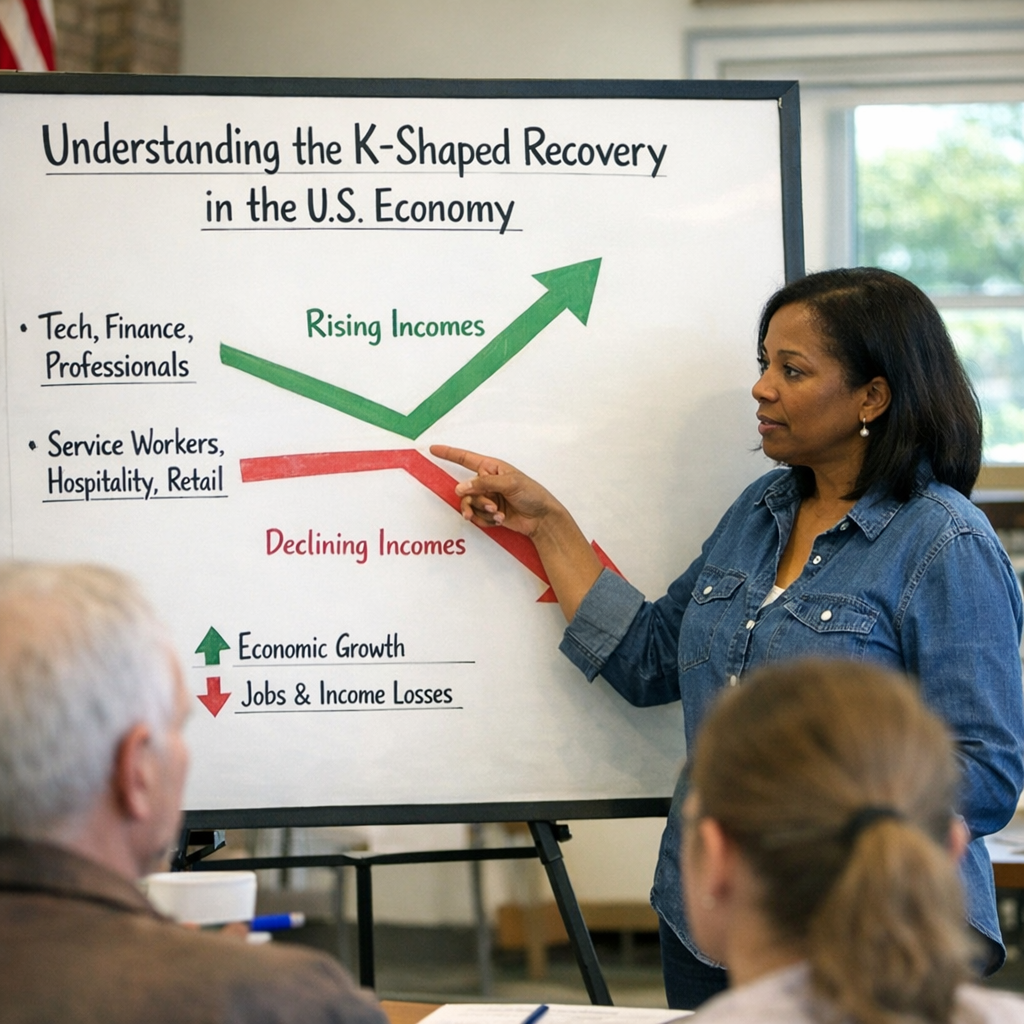
The term “K-shaped recovery” has become a focal point in discussions about the U.S. economy’s trajectory following recent challenges. This concept describes a scenario where different segments of the population experience divergent economic recoveries: some see improvements while others face stagnation or decline.
Defining the K-Shaped Recovery
In a K-shaped recovery, the economy splits into two distinct paths post-recession. One segment, often higher-income individuals and industries, experiences growth and prosperity. Conversely, another segment, typically lower-income groups and certain sectors, continues to struggle or decline.
Evidence from Recent Data
Recent analyses by the Federal Reserve Bank of New York confirm the presence of K-shaped dynamics in the U.S. economy. Since January 2023, real retail spending has grown unevenly across income groups. Wealthier individuals have driven much of this growth, benefiting from high returns on financial assets. In contrast, lower- and middle-income households have seen slower spending growth, especially after the expiration of pandemic-era relief programs. This reliance on affluent consumers has significant implications for economic stability and policy effectiveness. Notably, wage growth fails to fully explain this divergence; rising wealth and inflation play more significant roles. The Fed warns that this split leaves the economy more vulnerable to shocks.
Implications for Policy and Society
The K-shaped recovery underscores the need for targeted economic policies. Addressing disparities requires initiatives that support lower-income households, such as job training programs, educational opportunities, and social safety nets. Additionally, understanding these dynamics is crucial for businesses and policymakers aiming to foster inclusive growth.
As the U.S. continues its economic recovery, recognizing and addressing the factors contributing to this divergence will be essential in promoting a more equitable and resilient economy.